
Stamped Concrete Patios for Baxter Village Backyards: The Complete Guide
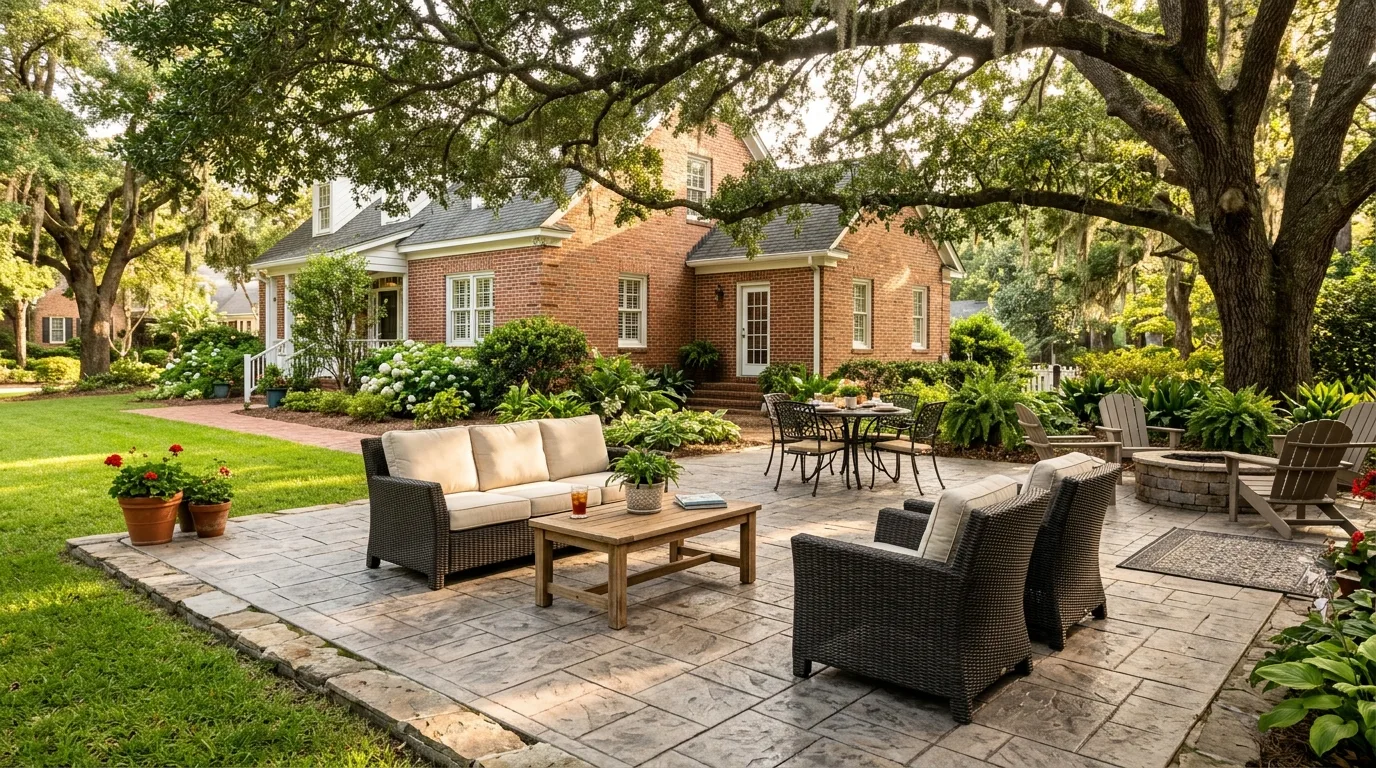
Baxter Village was designed as a master-planned community with outdoor living in mind — the walking trails, pocket parks, and mature landscaping throughout the neighborhood create a backdrop that makes the outdoor spaces around your home worth investing in. For homeowners who want a patio that complements that setting without the maintenance headaches of natural stone or wood, stamped concrete is the most practical and cost-effective decorative option available.
This guide covers everything Baxter Village and Fort Mill homeowners need to know about stamped concrete patios: pattern and color options, what the installation process involves, how the Carolinas climate affects installation and long-term care, and what to expect to pay in this market.
In this post, we will cover the most popular stamped concrete patterns for Baxter Village homes, how the installation process works, what York County’s climate means for stamped concrete performance, and the cost breakdown for patios in this market.
Design Your Stamped Concrete Patio in Baxter Village
We bring pattern samples and color charts to your property. Call (888) 376-0955 for a free design consultation and estimate.
Why Stamped Concrete Works Particularly Well in Baxter Village
Stamped concrete solves a real problem that Baxter Village homeowners face with alternative patio materials: York County’s expansive clay soils make pavers and flagstone problematic over time. Natural stone pavers installed on clay soil shift, settle, and develop gaps where weeds grow and drainage fails within 5 to 10 years. Stamped concrete is a monolithic slab — it may develop a crack or two over decades, but it does not shift individually or develop gaps that become maintenance problems.
The aesthetic flexibility of stamped concrete also suits Baxter Village’s diverse architectural styles — the community includes Craftsman bungalows, Lowcountry-influenced homes, and traditional colonials, and there are stamped patterns and color combinations that complement all of them.
Popular Stamped Concrete Patterns for Baxter Village Homes
Ashlar Slate — Large rectangular stone pattern with clean, modern lines. Works well with contemporary and transitional home styles. Available in charcoal, sandstone, and terra cotta color combinations.
Flagstone — Irregular natural stone look with varied sizes and organic joint lines. A particularly popular choice in Baxter Village for its natural appearance that blends with the community’s landscaping character.
Cobblestone — Traditional rounded-stone appearance, excellent for driveways, walkways, and patio borders. Adds historical character to traditional and Craftsman-style homes.
Roman Slate — Diagonal slate pattern that creates visual depth and interest. Works well for larger patios where a directional pattern helps define the space.
Wood Plank — Realistic wood board pattern that works well for covered porches and areas adjacent to wood-frame structures. Avoids the rot and maintenance issues of actual wood.
European Fan — Classic half-circle fan pattern associated with traditional brick work. Popular for pool surrounds and formal entry areas.
Color Options for Baxter Village Patios
Color is applied through integral pigment (mixed into the concrete before pouring), surface-applied color hardener, or a combination of both. Popular combinations for Baxter Village homes include:
Sandstone base with mocha release — Warm, neutral tones that complement brick and natural wood exteriors. The most requested combination in traditional community settings.
Charcoal base with black release — Contemporary look for modern and transitional homes. Creates a strong visual statement and hides surface dirt well.
Buff/cream base with tan release — Light, airy feel that works well in sun-exposed patios and pool surrounds. Reflects heat better than darker combinations.
Terra cotta base with brown release — Warm, earthy tones that pair well with Craftsman and Spanish-influenced architectural elements.
Not Sure Which Pattern and Color Is Right for Your Home?
We bring physical samples to your property during the estimate — see colors in your actual light conditions. Call (888) 376-0955.
How the Stamped Concrete Installation Process Works
Stamped concrete installation begins exactly like any quality concrete pour: proper excavation, compacted gravel base, moisture barrier, and reinforcement. The base is critical — a stamped surface on an inadequate sub-base will crack and shift the same as any other poorly prepared concrete in York County’s clay soil conditions.
After forming and before the pour, color hardener is staged for application. Once the concrete is poured and screeded, the surface color hardener is broadcast and worked into the surface while the concrete is still plastic. Release agent is then applied to prevent stamps from sticking and to add the secondary color variation that gives stamped concrete its natural stone appearance.
Stamping begins when the concrete reaches the right set consistency — firm enough to hold the impression but not so set that stamps cannot penetrate cleanly. This window varies with temperature and humidity, which is why experienced crews and favorable conditions matter. In Baxter Village’s hot summer conditions, the working window is shorter and requires a larger, faster-moving crew. In spring and fall, there is more margin.
After stamping and initial curing, the surface is cleaned with a neutralizer and then sealed. Sealing is essential for both color protection and freeze-thaw durability — an unsealed stamped concrete surface in York County will develop surface scaling within a few winters.
What the Carolinas Climate Means for Stamped Concrete Performance
York County’s freeze-thaw cycles require that any stamped concrete intended for outdoor use be made with air-entrained concrete — concrete mixed with 5 to 7 percent air content that allows water in the slab to expand during freezing without scaling the decorative surface. Non-air-entrained decorative concrete installed in this region will develop surface spalling that destroys the pattern within a few winters.
Summer heat in the Carolinas affects the stamping window — hot, dry, or windy conditions accelerate surface set time, leaving less margin for stamping. We schedule stamped pours for early morning in summer when possible and use evaporation retarder spray to extend the working window when conditions require it.
Resealing every 2 to 3 years is the most important maintenance step for Baxter Village stamped concrete — it protects color from UV fading and prevents water penetration. See our broader post on decorative concrete options for Baxter Village homes for detailed maintenance guidance.
What Stamped Concrete Patios Cost in Baxter Village
A plain concrete patio in Baxter Village runs $8–$18 per square foot. Stamped concrete adds $4–$12 per square foot above the base price:
- Single-color stamped pattern: $10–$16 per sq ft
- Two-color stamped pattern with release: $13–$20 per sq ft
- Custom multi-color design with border: $16–$25 per sq ft
A 400 sq ft stamped concrete patio runs approximately $5,000–$10,000 for mid-range designs. High-end custom work with multiple colors, hand-detailing, and architectural borders runs $10,000–$15,000 for the same area.
For Baxter Village homes with median values around $480,000, a $7,000 stamped patio represents roughly 1.5% of home value and typically returns more than its cost in increased outdoor living quality and resale appeal.
Use our concrete cost calculator to estimate your project, or compare your options in the full cost guide for Baxter Village concrete work.
Build the Stamped Patio Your Baxter Village Home Deserves
Baxter Village Concrete handles design, permitting, pour, and sealing. Call (888) 376-0955 for a free estimate with pattern samples.
Related reading: