The Best Time of Year to Pour Concrete in Fort Mill, SC
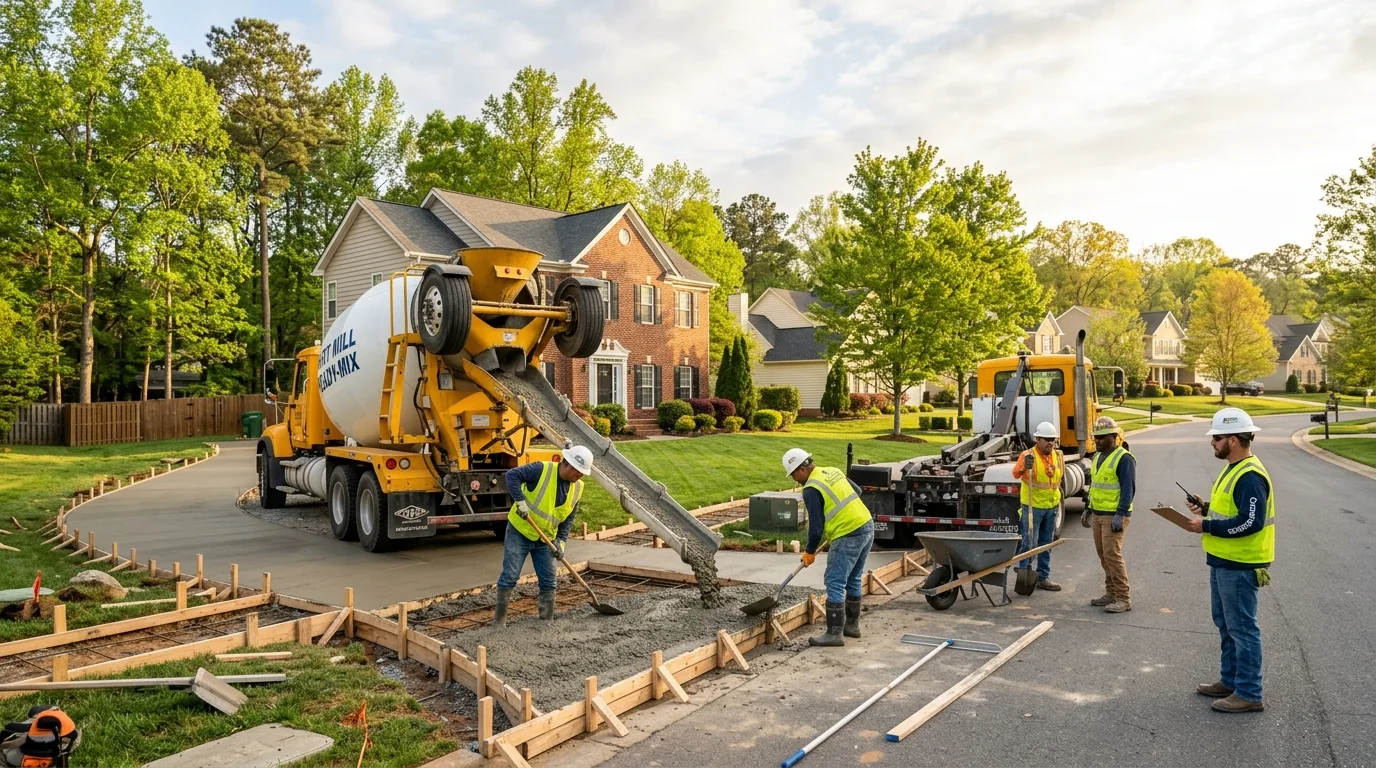
Timing a concrete pour correctly is one of the most underappreciated factors in a successful installation. Concrete poured in the wrong conditions — too hot, too cold, too windy, or during heavy rain — can lose 20 to 30 percent of its design strength, develop premature surface cracking, or fail to bond properly. In Fort Mill and Baxter Village, the Carolinas climate creates specific seasonal considerations that homeowners should understand before scheduling their project.
This guide explains the optimal seasons for concrete work in Fort Mill, what temperature thresholds matter, what special procedures are required in summer and winter, and how to book your project to get the best results at the best availability.
In this post, we will cover the ideal installation windows for Baxter Village concrete work, temperature and weather requirements for concrete pours, summer and winter concrete considerations in the Carolinas, and how to plan your project timeline for the best results.
Planning Concrete Work in Baxter Village or Fort Mill?
We help you schedule for optimal conditions and handle weather contingencies. Call (888) 376-0955 for a free estimate and availability.
The Ideal Concrete Season: April Through October
The broadest optimal window for concrete installation in Fort Mill and Baxter Village is April through October. During these seven months, temperatures generally stay above 50°F and below 95°F during the day, precipitation follows predictable patterns, and curing conditions are manageable with standard practices.
Within this window, two narrower periods stand out as truly optimal:
Spring: Mid-April through early June This is the best concrete season in the Carolinas. Air temperatures in the 65 to 80°F range, moderate humidity, and the absence of both winter freeze risk and peak summer heat create near-ideal curing conditions. Concrete poured in spring typically achieves full design strength with minimal intervention. This is also when most homeowners schedule exterior work, which means contractor availability books up quickly. Book spring projects in January or February to secure your preferred dates.
Fall: September through October Late summer temperatures have moderated, humidity drops, and the freeze risk is still weeks away. Fall is the second-best window and often has better contractor availability than spring. September and October pours in Baxter Village deliver the same quality results as spring with less scheduling competition.
Summer Concrete: July and August
Summer concrete pours in Fort Mill and Baxter Village are common and produce good results with proper precautions. The challenges are:
High temperatures: When air temperature exceeds 90°F and concrete surface temperatures reach 100°F or above, rapid moisture evaporation can occur before the concrete has cured sufficiently. This moisture loss causes plastic shrinkage cracking in the surface — fine cracks that form before the concrete even sets.
Hot concrete mix: Ready-mix concrete trucks traveling to a Fort Mill job site in summer heat deliver concrete at higher temperatures than specified, which accelerates the set time and reduces the working window.
Curing attention required: South Carolina’s summer heat means concrete poured in hot/windy conditions without proper curing attention can lose 20 to 30 percent of its design strength. We mitigate this by scheduling pours for early morning when temperatures are lowest, using curing compound or wet curing methods, shading the slab with wet burlap or curing blankets when necessary, and adjusting concrete mix temperature by using chilled mix water when conditions are extreme.
Summer pours are appropriate for most projects when managed correctly. The additional steps add minor cost — usually $0.25 to $0.75 per square foot — but protect the full strength of the finished concrete.
Summer Concrete Work in Baxter Village?
We manage hot-weather curing to protect your concrete's full design strength. Call (888) 376-0955 for scheduling and a free estimate.
Winter Concrete: November Through March
York County experiences freeze-thaw cycles from November through February, with temperatures occasionally dropping below 32°F. Concrete should not be placed when ambient temperature is below 40°F and falling without cold-weather protection measures in place.
The freeze risk: Concrete generates heat as it cures (the hydration reaction), but in cold conditions, heat loss exceeds heat generation and the concrete can freeze before it has reached adequate strength. Frozen concrete that has not yet cured will be permanently weakened — the ice crystal damage cannot be reversed.
Cold-weather concrete measures we use:
- Accelerated admixtures that speed the set time and reduce cold exposure risk
- Heated enclosures when temperatures are expected below 35°F
- Concrete mix with lower water-cement ratio that generates more hydration heat
- Insulating curing blankets that retain heat during the critical first 24 to 48 hours
Winter concrete is feasible for projects where scheduling is critical, but it adds cost and requires monitoring for the first few days. For non-urgent projects, scheduling for spring or fall avoids the complexity entirely.
Note for stamped concrete: We generally do not recommend stamped concrete pours in winter in Baxter Village. Color hardener does not cure properly at low temperatures, and the reduced working window makes achieving consistent pattern impression more difficult. Save stamped work for spring or fall.
Why the Carolinas’ Humidity Matters
Fort Mill’s climate is classified as DOE Climate Zone 3 — mixed-humid. The humidity itself does not prevent good concrete work, but it does affect finishing. In very high humidity (above 85 percent relative humidity), the surface of freshly finished concrete may stay moist longer, delaying the finishing schedule and requiring experienced judgment about when each finishing step should occur. Our crews monitor conditions throughout the pour and adjust finishing timing accordingly.
How to Book Your Concrete Project for Best Results
Spring (April–June): Book in January or February. These months book fastest in the Fort Mill market.
Summer (July–August): Book 4 to 6 weeks in advance. Early morning scheduling slots for summer heat management fill first.
Fall (September–October): Book in July or August. Fall availability is better than spring but still books 4 to 6 weeks out for quality contractors.
Winter (November–March): Last-minute availability is often possible, but cold-weather requirements and weather delays can extend timelines unpredictably.
For any project requiring York County permits, add 2 to 4 weeks to the timeline for permit processing. For Baxter Village HOA projects, add 2 to 4 additional weeks for ARB review. See our concrete permit guide for York County for details on the permit process.
Schedule Your Baxter Village Concrete Project Now
Spring books fast in Fort Mill. Call Baxter Village Concrete at (888) 376-0955 to secure your preferred installation window.
Related reading: