
Concrete Driveway Maintenance Tips for Baxter Village Homeowners
A concrete driveway that lasts 35 years instead of 20 is not about luck — it is about a simple maintenance routine that most homeowners either do not know about or do not follow consistently. In Baxter Village and Fort Mill, York County’s clay soils, freeze-thaw cycles, and South Carolina’s heavy rainfall create specific conditions that make maintenance more important than in regions with more stable soils and milder climates.
This guide covers the maintenance steps that extend concrete driveway life in Baxter Village: when and how to seal, how to handle cracks before they become replacement-level damage, what to avoid, and what signs indicate you need professional attention.
In this post, we will cover sealing schedules specific to York County’s climate, crack monitoring and repair timing, cleaning best practices, things that damage concrete in South Carolina, and how to recognize when a maintenance issue has become a structural problem.
Need Concrete Sealing or Crack Repair in Baxter Village?
We provide sealing and repair services for all concrete in Baxter Village and Fort Mill. Call (888) 376-0955 for a free assessment.
Why Maintenance Matters More in York County
York County’s conditions accelerate concrete deterioration more than many homeowners expect:
Clay soil movement: The shrink-swell cycle of York County’s expansive clay soils puts stress on driveways year-round. This stress is not visible from the surface, but it gradually opens hairline cracks that — once opened — allow water entry that accelerates the cycle. Sealing keeps water out of those early cracks before they grow.
Freeze-thaw cycles: While moderate compared to northern states, York County does experience winter freeze events. Water that has entered cracks or pores in unsealed concrete expands when it freezes, widening cracks further. This is the primary cause of surface scaling in Baxter Village driveways that were never properly sealed.
UV and weather exposure: South Carolina’s sun intensity is significant. Without a UV-protective sealer, concrete surfaces oxidize and become porous over time, accelerating moisture uptake and chemical attack.
The Sealing Schedule for Baxter Village Driveways
New driveways: Do not seal for the first 28 to 90 days. Concrete needs time to cure and off-gas before sealer application. Sealing too early can trap moisture and interfere with hydration. Most manufacturers recommend waiting 30 to 90 days depending on the product.
After first application: Reseal every 5 to 7 years for penetrating silane/siloxane sealers (the best choice for York County’s conditions). These sealers penetrate the concrete and chemically bond, providing freeze-thaw protection and water resistance without creating a surface film that can peel.
Stamped concrete: Reseal every 2 to 3 years with a compatible film-forming sealer that maintains color and sheen. The decorative surface requires more frequent sealing than plain concrete.
Timing: Apply sealer in spring or fall — temperatures between 50 and 90°F with no rain forecast for 24 hours. Never apply sealer to wet concrete or in direct summer sun.
Product selection: For Baxter Village driveways, silane/siloxane penetrating sealers are the best choice for plain concrete. Acrylic sealers are appropriate for stamped work where gloss and color enhancement are desired. Avoid cheap big-box store sealers with low silane content — professional-grade products last significantly longer.
Need Your Baxter Village Driveway Sealed?
Professional sealing with the right product for York County's conditions. Call (888) 376-0955 for a quote.
Crack Monitoring and Repair
How to monitor: Photograph any cracks twice a year — spring and fall. Measure width with a coin for reference. If a crack is growing in length or width, it is active and should be addressed before winter.
When to fill: Fill cracks when they reach 1/8 inch (about the thickness of a credit card) before they widen further. Hairline cracks that are stable (not growing) can be monitored without immediate action but should be sealed annually.
Repair materials: For cracks in Baxter Village driveways, use polyurethane crack filler — it is flexible enough to accommodate the movement that York County’s clay soils cause, unlike rigid epoxy fillers that can re-crack at the edges. Clean the crack thoroughly before filling and apply with a caulk gun for neat, consistent results.
When to call a professional: Any crack wider than 3/8 inch, any crack that has caused section elevation difference (one side higher than the other), and any crack you have filled that has re-opened within one season are signs of active sub-base movement that requires professional assessment.
Cleaning Recommendations
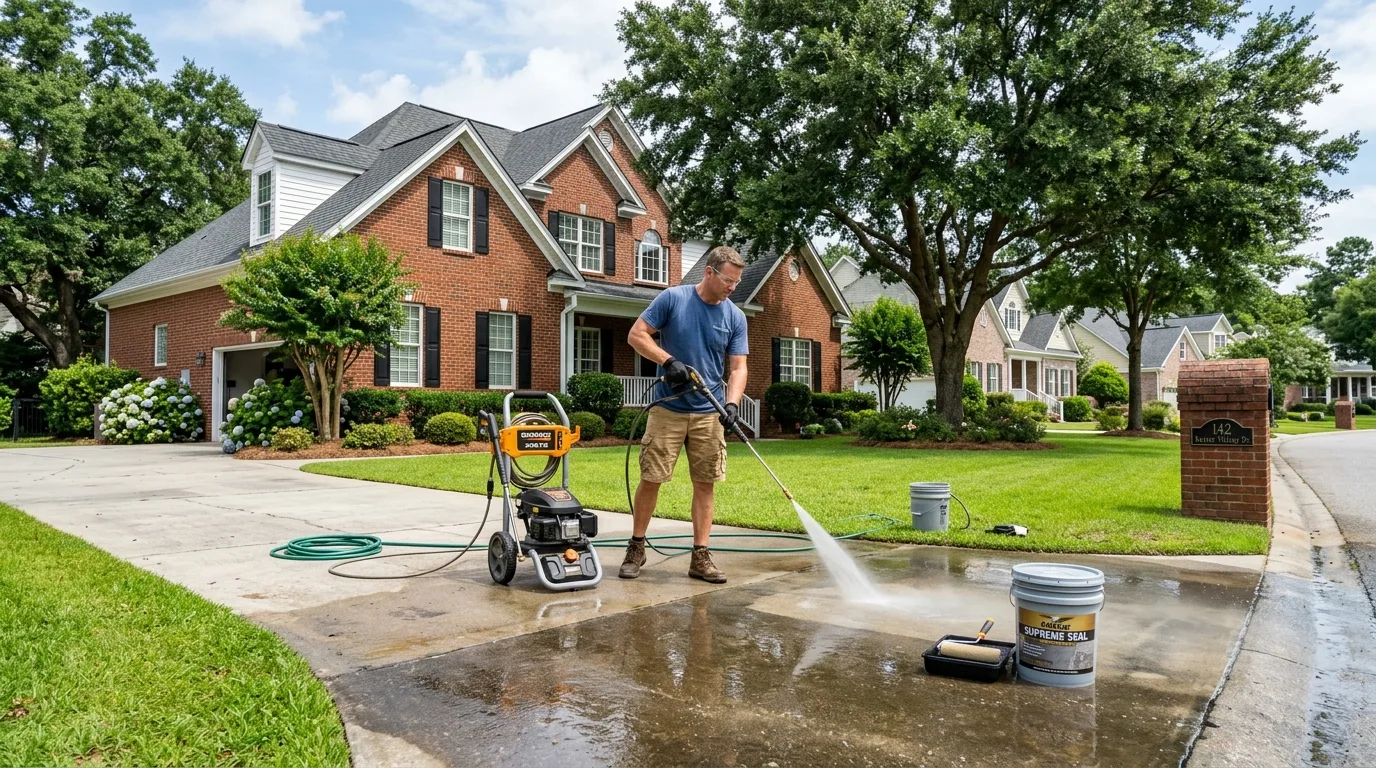
Regular cleaning: Rinse with a garden hose or pressure washer (maximum 2,500 PSI, fan tip) monthly during heavy-use periods. Remove debris before it stains.
Oil and fluid stains: Apply a degreaser promptly — oil allowed to penetrate concrete is very difficult to remove completely. Cat litter or baking soda absorbs fresh oil spills before they penetrate.
Pressure washing caution: Concrete can be damaged by overly aggressive pressure washing. Keep the nozzle moving, use a fan tip not a pinpoint tip, and do not hold the wand directly on one spot. On stamped or sealed concrete, use lower pressure (1,500 PSI) to avoid damaging the sealer.
What to Avoid on Your Baxter Village Concrete Driveway
Rock salt / sodium chloride ice melt: This is the single most damaging material commonly applied to concrete driveways. Salt lowers the freezing point of water, but the freeze-thaw cycle it creates in the surface pores — combined with the chemical attack of chloride on concrete — causes rapid surface scaling and spalling. Use sand for traction instead. Calcium magnesium acetate (CMA) is the safest chemical ice treatment for concrete if needed.
Heavy vehicle overloading: Residential concrete driveways are typically designed for standard passenger vehicles. Repeated parking of loaded dump trucks, heavy equipment, or large RVs on a 4-inch residential slab will cause cracking. If you regularly park heavy vehicles, consider a thicker pour (5 to 6 inches) for designated areas.
Tree roots: Baxter Village’s mature landscaping means established trees near driveways. Roots from trees within 15 feet of a driveway can grow beneath the slab over time, causing lifting and cracking. Monitor for surface displacement near trees and trim roots proactively during any driveway replacement.
When Maintenance Has Become a Structural Problem
Maintenance keeps good concrete good. It cannot save fundamentally compromised concrete. These signs indicate you have moved from maintenance territory into repair or replacement:
- Cracks reopen within one season of being filled (active sub-base movement)
- Multiple sections have shifted more than 1/2 inch relative to each other
- Water pools in persistent low spots that do not drain after rain
- Spalling covers more than 25% of the surface
See our guide on 5 signs your Baxter Village driveway needs replacement, not just repair for a detailed breakdown.
Concrete Maintenance, Sealing, and Repair in Baxter Village
Baxter Village Concrete provides complete driveway care — from sealing to repair to replacement. Call (888) 376-0955 for a free assessment.
Related reading: