Concrete Resurfacing: A Cost-Effective Option for Aging Driveways in Fort Mill
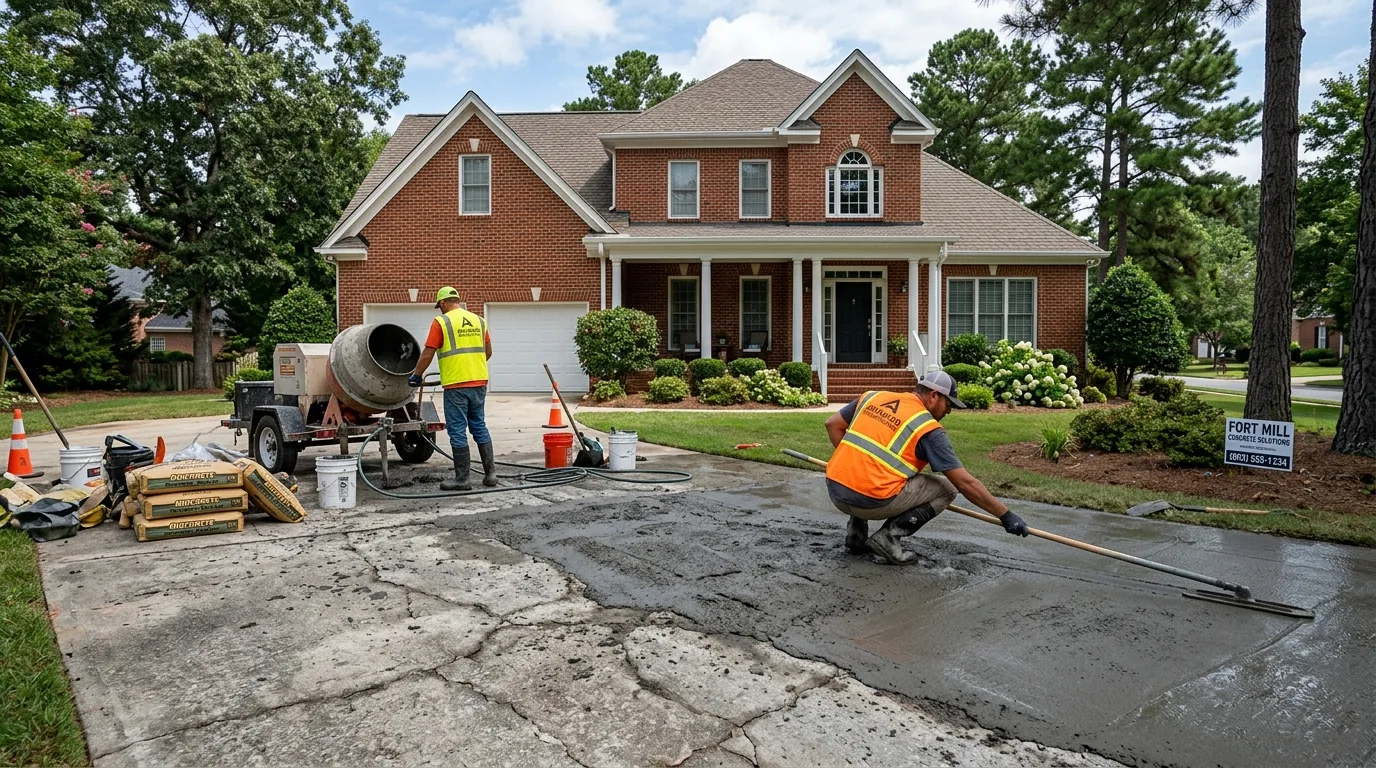
Concrete resurfacing is one of the most misunderstood options in the concrete repair toolkit. It can be an excellent, cost-effective way to restore a driveway that looks worn but is structurally sound — and it can be a waste of money when applied to a driveway with sub-base problems that the overlay cannot fix. For Baxter Village and Fort Mill homeowners whose driveways are showing their age after 15 to 20 years, understanding when resurfacing works is the key to spending money wisely.
This guide explains what concrete resurfacing is, when it makes sense for Baxter Village driveways specifically, when it does not, what the process involves, and what you can realistically expect to pay in the Fort Mill market.
In this post, we will cover what resurfacing actually does to the concrete surface, the conditions that make resurfacing viable vs. not, what the installation process looks like, cost ranges for Fort Mill, and how resurfacing compares to full replacement economics.
Is Resurfacing the Right Option for Your Baxter Village Driveway?
We provide honest assessments of whether resurfacing or replacement makes more sense for your specific situation. Call (888) 376-0955.
What Concrete Resurfacing Is
Concrete resurfacing applies a polymer-modified overlay — typically 1/4 to 1/2 inch thick — to an existing concrete surface. The overlay bonds to the existing concrete and provides a new surface layer that restores appearance, adds texture, and covers surface-level damage.
Resurfacing is not a structural fix. It cannot address:
- Cracks that go through the full depth of the slab
- Sections that have settled, heaved, or shifted
- Sub-base voids or erosion beneath the slab
- Active clay soil movement causing ongoing concrete movement
What resurfacing does address:
- Surface scaling and spalling confined to the top layer
- Widespread surface wear and oxidation
- Cosmetic cracks that are stable (not growing) and surface-level
- Color fading and overall appearance deterioration
When Resurfacing Makes Sense for Baxter Village Driveways
The ideal candidate: A Baxter Village driveway that is 15 to 25 years old, has a few surface cracks that have been stable for several years, shows significant surface spalling or wear over more than 30% of the surface, but has sections that are still essentially level — no significant heaving or settling — and no evidence of sub-base problems (no rocking sections, no water pooling in persistent low spots).
This profile describes a meaningful portion of original Baxter Village driveways from the 2000 to 2010 era: the concrete is past its prime cosmetically but the structural situation is still manageable. Resurfacing can add 8 to 15 years of service life to this type of driveway at a fraction of the cost of full replacement.
Cost comparison:
- Full driveway replacement (2-car, 400 sq ft): $3,500–$8,000
- Concrete resurfacing (same driveway): $1,200–$3,200
- Potential savings with resurfacing: $2,000–$5,000
The savings are real when resurfacing is appropriate. When it is not appropriate — when sub-base issues are present — the savings evaporate quickly as the overlay fails within 2 to 3 years.
Is Your Baxter Village Driveway a Resurfacing Candidate?
We assess the structural condition honestly before recommending resurfacing. Call (888) 376-0955 for a free evaluation.
When Resurfacing Does Not Make Sense
Active sub-base movement: York County’s clay soils cause active movement in many driveways — sections that are still slowly shifting. Resurfacing a driveway with active sub-base movement will result in the overlay cracking within 1 to 2 seasons as the movement propagates through the thin overlay material. The fix for active sub-base movement is replacement with proper base preparation, not surface treatment.
Widespread full-depth cracking: If cracks run through the full thickness of the concrete and have caused any section displacement, resurfacing cannot hold the sections together and will simply crack along the same lines.
Sections that have settled or heaved more than 1/2 inch: The overlay cannot bridge significant elevation differences. Sections must be within 1/4 inch of each other for resurfacing to achieve an acceptable result.
Drainage failure: If water pools persistently on the driveway surface, the slope has changed due to settlement. Resurfacing at a uniform thickness does not correct slope — only regrading or replacement does.
The Resurfacing Process
-
Surface preparation: Existing concrete is pressure washed and all loose material, oil stains, and surface contamination is removed. This is the most critical step — an overlay that does not bond will delaminate. Cracks wider than 1/4 inch are filled before the overlay is applied.
-
Primer application: A bonding primer is applied to the clean concrete surface to ensure adhesion of the overlay material.
-
Overlay application: Polymer-modified concrete overlay is mixed and applied with a squeegee or trowel to the specified thickness. For decorative overlays, stamps, stencils, or texture rollers may be applied before the material sets.
-
Curing: The overlay must cure for 24 to 48 hours before foot traffic and 7 days before vehicle traffic.
-
Sealing: A sealer compatible with the overlay material is applied after full cure for protection and appearance.
Resurfacing Costs in Fort Mill
Plain resurfacing (broom texture): $3–$8 per square foot Decorative resurfacing (stamped overlay, stencil pattern): $6–$15 per square foot
For a standard 400 to 500 square foot two-car driveway in Baxter Village:
- Plain resurfacing: $1,200–$4,000
- Decorative resurfacing: $2,400–$7,500
These costs are meaningfully lower than full replacement when the underlying slab is structurally viable. They become poor value when the slab is not a good candidate, because overlay failure happens faster than original concrete failure.
How Long Resurfacing Lasts in the Carolinas
Done correctly on a viable base, concrete resurfacing in South Carolina lasts 8 to 15 years. The primary lifespan factors:
- Bond quality: The overlay must be applied to properly prepared, clean concrete. Contamination or moisture at the bond line causes premature delamination.
- Sealing: Resurfaced concrete should be sealed every 3 to 5 years with a compatible sealer.
- Sub-base stability: Any ongoing movement in the original slab will crack the overlay. The overlay does not prevent the original slab from moving.
See our maintenance guide for Baxter Village concrete driveways for resurfacing-specific maintenance tips, and our comparison of 5 signs your Baxter Village driveway needs replacement to help determine which option is right for your driveway.
Baxter Village Concrete — Honest Assessments, Lasting Results
We tell you whether resurfacing or replacement makes more sense for your specific driveway — no upselling. Call (888) 376-0955.
Related reading: