
Why York County's Expansive Clay Soil Affects Your Concrete in Baxter Village
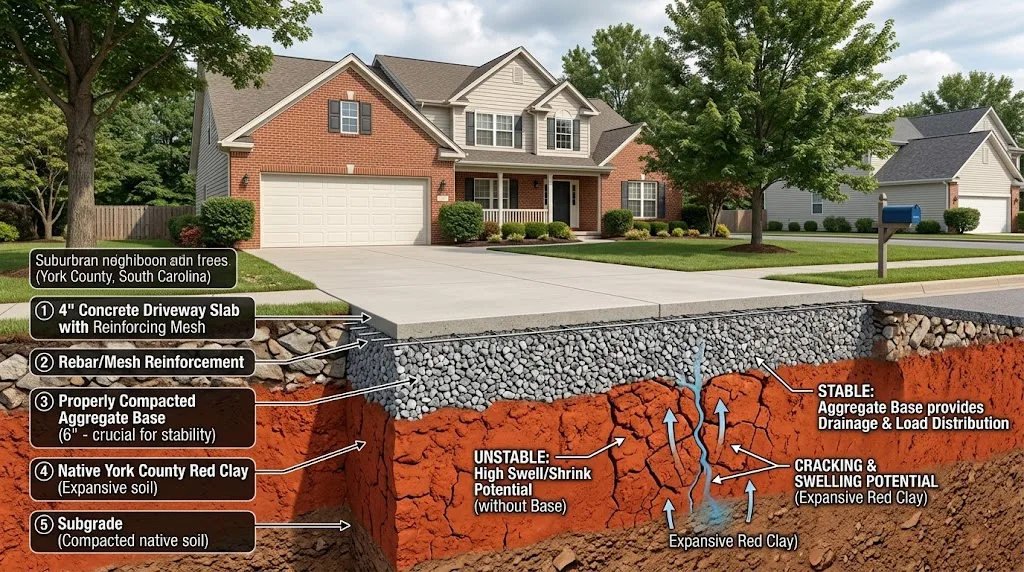
If you have noticed cracks developing in your Baxter Village driveway, patio, or walkway within the first few years after a pour — or if sections have shifted noticeably — the soil beneath it is almost certainly part of the cause. York County’s clay-rich Piedmont soils are among the most challenging substrates for concrete in the Carolinas, and understanding how they work helps you make better decisions about base preparation, maintenance, and when to repair vs. replace.
This post explains exactly what expansive clay soil is, how it damages concrete in Baxter Village, what proper base preparation looks like to counteract it, and what warning signs indicate that a sub-base problem has already developed beneath your concrete.
In this post, we will cover the mechanics of clay soil expansion, how this affects concrete driveways and foundations specifically, what base prep specifications protect against it, and what signs of sub-base failure look like from the surface.
Concrete Problems in Baxter Village? Let Us Assess the Root Cause.
We diagnose concrete problems correctly and recommend solutions that address the underlying soil conditions. Call (888) 376-0955.
What Expansive Clay Soil Is and Why York County Has It
Expansive clay soils — sometimes called shrink-swell soils — are soils with a high content of specific clay minerals that change volume significantly with moisture. When wet, these minerals absorb water and swell. When dry, they lose that water and contract, shrinking and cracking.
York County sits in the South Carolina Piedmont region, where the underlying rock types — primarily metamorphic and igneous — have weathered over millions of years into clay-rich soils. The Charlotte to Fort Mill corridor sits on some of the most clay-intensive soil in the two-state region. This is not a defect specific to Baxter Village — it is a regional geology condition that affects all concrete work across York County.
The practical result: the soil beneath your driveway, patio, or foundation is constantly changing volume with seasonal moisture cycles. After heavy spring rains, it expands. After dry summer months, it contracts and pulls away from concrete edges. After winter freeze-thaw, saturated areas expand again. This cycle repeats every year, and concrete that is not protected from it by proper base preparation will eventually crack, shift, or settle.
How Clay Soil Damages Concrete Driveways in Baxter Village
Slab heaving: When saturated clay soil beneath a slab expands upward, it lifts sections of the concrete unevenly — one section rises while adjacent sections stay put, creating a step or hump that becomes a trip hazard and causes cracking at the joint.
Slab settlement: When dry clay soil contracts and pulls away from the slab surface, voids form beneath the concrete. The slab, now unsupported in that area, sags under its own weight and the loads placed on it, eventually cracking.
Edge cracking: The edges and corners of driveways are most vulnerable because soil moisture varies more at the edges — adjacent to grass and landscaping — than under the center. Edge cracks are often the first sign of shrink-swell damage.
Root intrusion: Baxter Village’s mature landscaping — a feature of the master-planned community near the Anne Springs Close Greenway — creates another clay soil complication: established tree roots seek moisture and will grow toward and under concrete slabs over time. Root intrusion combined with clay soil movement accelerates cracking and displacement, particularly in sidewalks and walkways near established trees.
Concrete Cracking in Your Baxter Village Home?
Our free assessment identifies whether soil conditions are the root cause. We explain exactly what we find. Call (888) 376-0955.
What Proper Base Preparation Looks Like
The solution to clay soil risk is well-established in the concrete industry: you do not pour concrete directly onto native clay. Proper base preparation involves:
Excavation: Remove the native clay soil to the required depth — typically 8 to 10 inches below the finished surface grade for a 4-inch slab on 6 inches of base material.
Base material: Replace the native clay with compacted crushed stone aggregate (AASHTO #57 stone or equivalent). Crushed stone does not exhibit shrink-swell behavior — it drains freely and maintains consistent bearing capacity regardless of moisture.
Compaction: The base material must be mechanically compacted in lifts to prevent settling after the slab is poured. Dumping gravel and pouring concrete over it without compaction is not adequate — the uncompacted base will settle under load.
Drainage: The base should be graded to drain water away from the slab rather than allowing it to pool beneath. Poor drainage is one of the most common causes of premature clay soil damage — water that cannot drain accelerates the expansion cycle.
Reinforcement: For driveways on clay soils, rebar reinforcement (not just wire mesh) is the better choice. Rebar holds cracked sections together if movement occurs, preventing the sections from separating and creating the hazardous step conditions that commonly develop on unreinforced slabs.
Control joints: Cut at 8 to 12 foot intervals, control joints give the concrete a place to crack in a controlled manner along a straight line, rather than cracking randomly across the surface.
Signs of Sub-Base Problems You Can See From the Surface
Even without excavating, these surface signs indicate that clay soil movement has compromised the sub-base:
- Rocking slabs: A section that rocks slightly when you step on it has a void beneath it — the sub-base has pulled away.
- Water pooling after rain: Low spots indicate settlement — the slab is following the soil downward.
- Cracks that reopen after filling: A crack that was filled and has reopened within one or two seasons has active sub-base movement driving it.
- Steps at control joints: One section rising or falling relative to the adjacent section indicates differential movement — classic shrink-swell behavior.
- Edge separation: Gaps opening between the driveway edge and the adjacent soil or landscaping mean the soil is contracting away from the slab.
Why This Matters for New Concrete Installations
If you are getting estimates for a new driveway or patio in Baxter Village, ask every contractor explicitly: “How deep is your base, and what material do you use?” A contractor who proposes 4 inches of gravel on native clay or who cannot clearly answer this question is likely to deliver a slab that will show problems within 5 to 10 years in York County’s soil conditions.
The base preparation difference between a cheap estimate and a quality estimate is often $500 to $1,400 on a standard two-car driveway — money that prevents thousands in premature repairs.
For more on what a proper driveway installation looks like, see our concrete driveway service page or read our guide on concrete driveway costs in Baxter Village.
Concrete Built for York County's Clay Soils
Baxter Village Concrete uses the base preparation specifications that York County's conditions require. Call (888) 376-0955 for a free estimate.
Related reading: